|
Brighton: Booth Museum of Natural History - Has a number of meteorites in their geology collection. These are NOT on public display but can be viewed on request (Please contact the museum in advance if you would like to see them). The collection consists of Brenham (15g fragment), Forest City (20g and 74.8g), Pultusk (213g individual), Estherville (26g cut section, 20g uncut), casts of Middlesborough, Nedagolla and Daniel's Kuil plus 7 Australite tektites. There is also a a selection of stones used for handling during educational work: Canyon Diablo (424g individual), Gibeon (87g etched slice), Mount Tazerzait (25.5g slice), Imilac (12.4g) plus a number of tektites and meteorwrongs.
Cambridge: Sedgwick Museum Of Earth Sciences - The museum's website infers (here) that there are meteorites on display. Awaiting further details.
Exeter: Royal Albert Memorial Museum & Art Gallery - According to an article here, "This ordinary looking rock was spotted in RAMM's collection about 15 years ago. It was immediately identified as a meteorite". On the page for Roger Taylor, the museums geologist, he mentions "the meteorite that is the oldest object in the collection". The meteorite is expected to go on display when current renovation work on the museum is complted. Roger Taylor stated via email "Regrettably there is little information on the origin of the meteorite. I 'found' it in a box a few years back, the label was indecipherable. The only reference I could find in the museum records was for a meteorite said to come from the Malay States. However, there no direct
indication that the specimen we have is that recorded. On the other hand, meteorites are not that common that it is likely that the RAMM has two. The meteorite is in a very fresh state with only a little alteration where a small fragment has been knocked off either on impact or when it was collected. It has a nice black fusion skin except at this point. It is a common chondrite with distinct chondrules, pyroxene and olivine set in a nickel iron matrix. The chondritic identification was confirmed by the Natural History museum who have registered it and provided the RAMM with a thin-section which is available for examination."
Hull: Hull and East Ridings Museum - Has small specimens of Sikhote Alin, Campo del Cielo, Nantan and a Moroccan ordinary chondrite, but these are not on permanent display.
Knutsford: Tatton Park - Tatton park is a National Trust property in Cheshire. One room of the house contains the Maurice Egerton Collection. This includes a large iron meteorite (~420 mm x 320 mm x 240 mm, mass over 300lbs), which is believed to be Gibeon.
Leeds: Leeds Museum Discovery Centre - Collection includes four meteorite specimens: Henbury (iron, small entire meteorite), Toluca (etched iron, slice of large mass), Brenham (pallasite, small slice), Imilac (pallasite, small weathered piece). Visits are by appointment only.
Leicester: New Walk Museum and Art Gallery - Part of the Barwell meteorite is usually on display but the geology gallery is currently closed and not due to re-open until 2011.
Leicester: National Space Centre - Has had a piece of Nakhla, an iron meteorite and a sizable piece of Barwell on display previously. Awaiting details of current public display.
 |
Liverpool: World Museum - A permanent display includes examples of Alfianello, Barwell, Mbale, Millbillillie, Zagami, Vaca Muerta, Imilac (slice and whole specimen), Canyon Diablo, Sikhote-Alin, Gibeon (slice and whole specimen), Odessa, Toluca and Henbury.
|
London: Natural History Museum - The museum houses one of the World's finest collections of meteorites, with around 2,000 individual specimens represented. There are two main public meteorite displays. Firstly in "The Vault": Nakhla (Martian; large fragment), Imilac (Pallasite; very large slice), Vigarano (CV3; slice), Canyon Diablo (Iron IAB; individual with etched face), Cold Bokkeveld (CM2; fragment) and DAG 400 (Lunar anorthositic breccia; large slice). Secondly in the Mineral Gallery: Ghubara (OC; ?slice), Wellman (a) (OC; end cut), Johnstown (Diogenite: end cut), Springwater (Pallasite; fragment with polished face), Crab Orchard (Mesosiderite; slice), Canyon Diablo (Iron IAB; large, etched slice), Laguna Manantiales Iron IIIAB; etched slice), Wabar (Iron IIIAB (end cut with etched face), Impact glass from Wabar craters, Henbury (Iron IIIA, individual), Stannern (Eucrite; large individual), Tenham (OC; large individual). A 1400lb Campo Del Cielo ("Otumpa") is visible in the Green Zone, Minerals. The 3.5 tonne Cranbourne 1 mass is visible in Red Zone, Earth Today and Tomorrow. In the Earth Hall, opposite the Exhibition Road entrance, you can see the 275kg Mundrabilla slice (1973,M.39). Images of many of these specimens can be seen on Mark Crawford's excellent London Meteorites website here.
London: Royal Observatory Greenwich - A blog posting mentioned an event including "a lighthearted tour of the Observatory's meteorite collection". Awaiting details of collection.
Manchester: Manchester Museum - A permanent display includes examples of Appley Bridge, Monze, Canyon Diablo, Turtle River, Odessa, Toluca, Brenham, Bondoc, Millbillillie, Allende, Bjurbole, Wells, Hedjaz, Sinai and Plainview.
Newcastle: Great North Museum - A small collection of meteorites are in the permanent display.
Oxford: Oxford University Museum of Natural History - The museum holds a large collection, of which the following are on display: Nantan, Sikhote-Alin, Gao-Guenie, Gibeon, Campo del Cielo, Imilac, Rewari and Limerick.
Saffron Walden: Saffron Walden Museum - The geology gallery contains a replica of the Ashdon meteorite that fell 7th June 1923.
Sheffield: Weston Park Museum - Has a small display containing three meteorites: Canyon Diablo (IAB), Trenton (IIIAB) and Allende (CV3).
Surrey: Haslemere Educational Museum - The Geology web page shows an image of a slice of the Estherville mesosiderite. Awaiting further collection details.
Tyne & Wear: The Sunderland Museum &
Winter Gardens and The Discovery Centre - There are six meteorites in the public display, see here for details, Sunderland specimens have the TWCMS prefix.
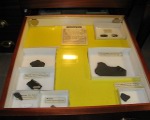 |
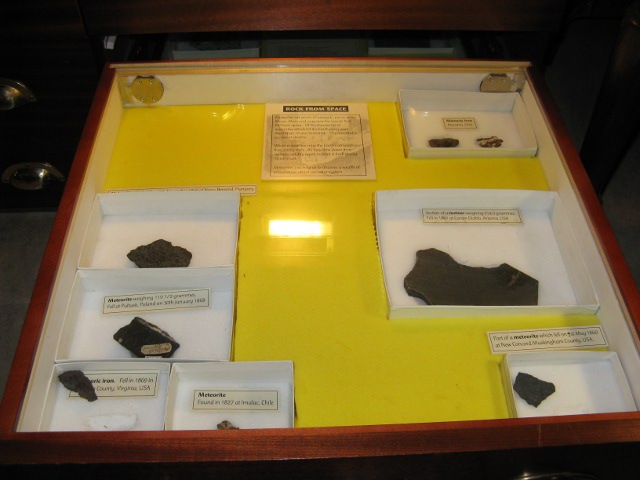
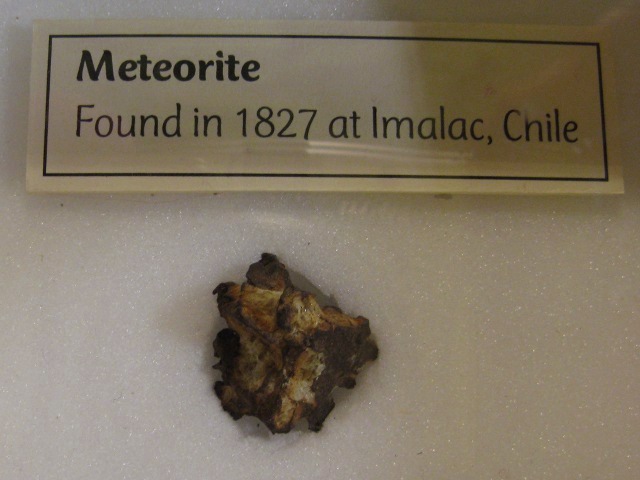
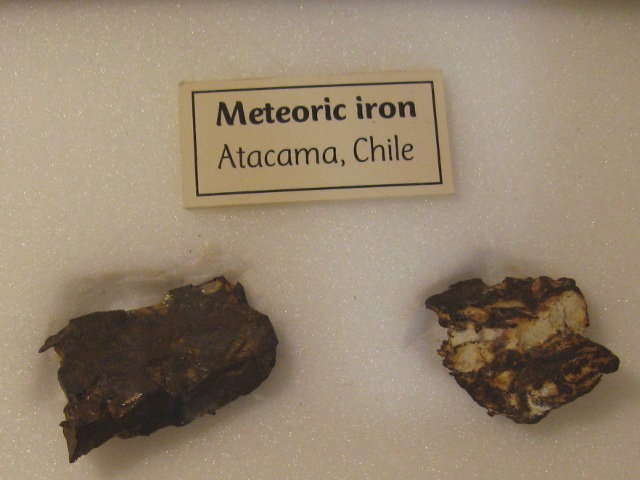
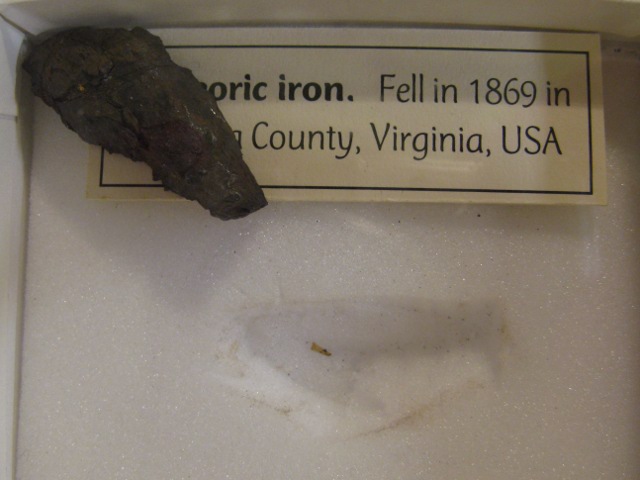
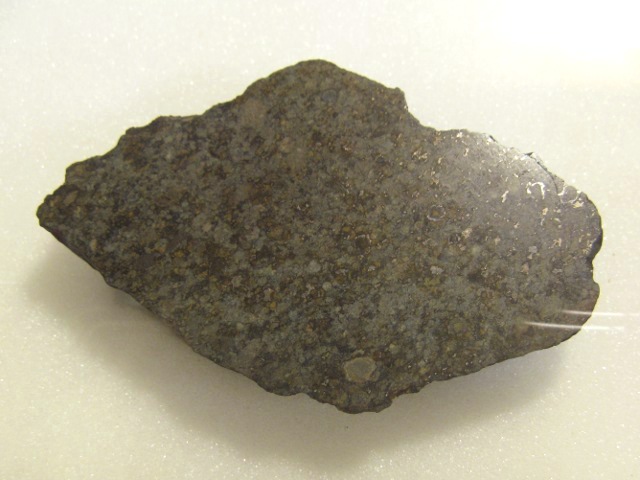
Warrington: Warrington Museum & Art Gallery - A single drawer labelled "Rocks from space" in the geology section contains eight meteorite specimens from six locations. Specimens include Imilac (3 specimens, image 1, image 2), Canyon Diablo (514.5g slice), New Concord, Pultusk (119.5g, image), Staunton (image) and a stone labelled "Meteorite which fell on 9th November 1866 at Nagy-Bereznd, Hungary" (image). It has been confimed that this final specimen is Knyahinya which fell on 9th June 1866 ("Nagy-berezna" is a synonym for Knyahinya).
|
York: Yorkshire Museum - A small meteorite collection including the Middlesbrough meteorite that fell on 4th March 1881. There is no permanent display, and no research/enquiries will be possible until December 2010, due to refurbishment of the museum.
|